1win Aviator Strategy Guide: How It Works, Real Odds and Bankroll Rules (2026)
The plane takes off, the multiplier climbs, and if you cash out before it flies away, you win. Those are the only rules. Aviator is the most played crash game at online casinos right now. This guide covers how it works and how to play it sensibly, with my own play data as I collect it.
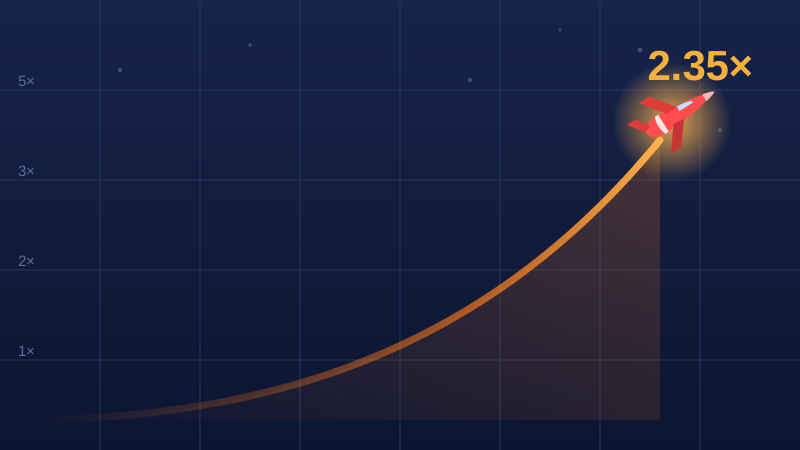
How Aviator works
When the round starts, the plane takes off and the multiplier rises from 1.00x in real time. You have one job: press "Cash Out" before the plane flies away (crashes).
- Cash out at 2.00x → you get double your stake back
- The plane crashes before you press → you lose the stake
The crash point is random every round. Sometimes it ends at 1.01x, sometimes it goes past 100x. The whole game is deciding when to get off.
Provably Fair: why it can't be rigged
A lot of players suspect the casino controls when the plane crashes. Aviator uses a system called Provably Fair to rule that out.
Each round's result is generated by a hash function from a server seed combined with seeds from players, and anyone can verify it after the round ends. That means neither SPRIBE (the developer) nor 1win can change a result after the fact. It's mathematically impossible. You can check the verification data for any round from the round history in the game.
How to play (the screen explained)
- Enter your stakeSet the amount in the bet box at the bottom of the screen. [Screenshot to be added]
- Press "Bet" to join the roundYour bet has to be placed before the round starts.
- Watch the multiplierIt climbs as the plane gains height.
- Hit "Cash Out" before the crashYour payout is locked at the multiplier shown when you press.
- (Recommended) Turn on auto cash-outIt cashes out for you at a multiplier you choose. This is the single most useful feature for keeping emotions out of it.
Aviator strategy: 3 ways to play
Let me be upfront. With an RTP of 97%, Aviator loses money over the long run. Nothing below guarantees a win. These are ways to make your bankroll last, avoid big losses, and bank the lucky streaks when they come.
Odds of reaching each multiplier
Before picking a style, know how often each multiplier actually shows up. Because Aviator's RTP is 97%, the theoretical chance of the plane reaching a multiplier x is roughly 0.97 ÷ x (a guide based on how the Provably Fair system is designed).
| Target multiplier | Chance of reaching it | In practice |
|---|---|---|
| 1.2x | ≈81% | Almost always (good for steady play) |
| 1.5x | ≈65% | About 3 rounds in 5 |
| 2x | ≈49% | Roughly a coin flip |
| 3x | ≈32% | About 1 round in 3 |
| 5x | ≈19% | About 1 round in 5 |
| 10x | ≈10% | About 1 round in 10 |
| 100x | ≈1% | 1 round in 100 (not something to chase) |
1. Low and steady (for beginners)
Set auto cash-out to 1.3x–1.5x and leave it there. Statistically, about a third of rounds crash below 1.5x. You win often, but each win is small, so pair this with the bankroll rules below to survive losing streaks.
2. The two-bet split (intermediate)
Aviator lets you place two bets in the same round. You can use that like this:
- Bet A (the safety net): auto cash-out at 1.5x to recover your stake
- Bet B (the swing): cash out by hand, aiming for 3x–10x
When Bet A lands, Bet B is close to free. This is the setup I use most myself.
3. Bankroll rules (for every player)
| Rule | Guideline |
|---|---|
| Maximum per bet | 1–2% of your total bankroll |
| Stop-loss per session | Stop as soon as you're down 20% |
| Take-profit | Up 30%? Withdraw and walk away |
| Doubling up to chase losses | Never (the Martingale is the fastest way to go broke) |
Can famous betting systems like the Martingale or Fibonacci actually beat Aviator? I run the math in Aviator betting systems: 5 strategies tested.
| Test date | [Test pending] |
|---|---|
| Method | Two-bet split (A: auto 1.5x / B: aiming for 5x) |
| Rounds played | [Test pending] |
| Result | [Test pending, screenshot to be added] |
"Winning tricks" and predictor apps: the truth
The same goes for the popular Aviator game trick of waiting for a run of low multipliers because "a big one is due". Every round is fully independent. Past results have no effect on the next round. Believing otherwise is the gambler's fallacy.